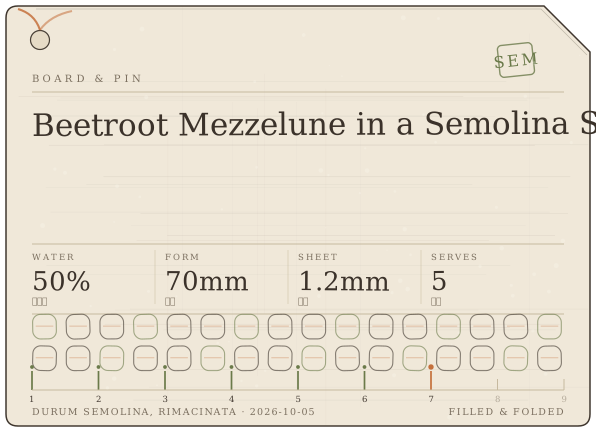
Semolina in the dough and beetroot in the filling is a deliberately dry pairing on both sides of the wall — the only way a 70 mm half-moon holds its arch on the tray instead of sagging into a flat crescent.
Flours
Durum semolina, rimacinata
Egg
Whole eggs and vegetable purée
Water
50%
Sheet
1.2 mm
Form
70 mm
Drying
Flat on a tray · 2h
Work
85 min + 30 min rest
Serves
5
1The ratio
Beetroot Mezzelune in a Semolina Sheet — 5 portions
Flour
g
baker’s %
Durum semolina, rimacinata
400
100%
Egg
3 whole eggs
50%
water
20
5%
purée
30
8%
olive oil
10
3%
salt
4
1%
Dough weight
614 g
50% Water
Per portion ≈ 123 g. Every ratio on this site is a baker’s percentage against the flour weight.
2The roller
mm
14.8 mm
24.2 mm
33.4 mm
42.6 mm
52 mm
61.6 mm
71.2 mm
80.9 mm
90.6 mm
Notch by notch1 → 2 → 3 → 4 → 5 → 6 → 7
Cut at 7 (1.2 mm) → 70 mm Form
3The filling
Beetroot, robiola and horseradish
Flour
350 g beetroot, roasted whole 60 minutes at 200 °C
220 g robiola or drained ricotta
40 g parmigiano
15 g fresh horseradish, grated
1 tbsp poppy seeds, toasted
5 g salt, black pepper
Method
Roast the beetroot whole, unpeeled, wrapped in foil. Whole roasting keeps the sugars in; boiling leaches them into the water and leaves you with a filling that tastes of soil.
Peel while warm with a cloth — the skin slips off — then grate on the coarse side of a box grater and dry in a pan for 3 minutes.
Beat the robiola with the parmigiano, horseradish and salt, then fold in the beetroot and the poppy seeds.
Chill 30 minutes. Beetroot filling stains everything, so work on a board you do not mind, and wear an apron.
Sauce for this
Beetroot butter with poppy seed
甜菜根黄油配罂粟籽
Beetroot butter with poppy seed and horseradish is sharp and slightly hot, which is what a sweet, earthy filling needs. A cream sauce would make the whole plate taste of sugar.
Holds 4% butter
Flour
300 g cooked beetroot, grated coarse
70 g butter
1 tbsp poppy seeds
1 tsp red wine vinegar
80 g robiola or ricotta
15 g horseradish, freshly grated
Method
Toast the poppy seeds in a dry pan for 40 seconds until they start to pop.
Add the butter and the beetroot; cook 4 minutes so the beet loses its raw edge.
Add the vinegar, which is what stops the whole dish tasting of earth.
Off the heat, fold in the robiola and the horseradish.
Beetroot needs acid. Without the vinegar the colour stays bright but the flavour reads flat and muddy.
Why semolina and not 00
A mezzelune is a single fold with a long curved seam and no internal support. The dough has to be stiff enough to hold an arch over 70 mm of span, and 00 at 50% hydration sags within ten minutes on the tray.
Semolina at the same hydration gives a sheet that stays where you put it. It is also the traditional pairing for beetroot in the north-east of Italy, where the filling is more often served with a firm dough than a soft one.
Keeping the colour
Beetroot pigment is water-soluble and heat-sensitive. Two things keep it: roasting rather than boiling, and adding acid at the end of the filling rather than the start.
Half a teaspoon of red wine vinegar in the filling holds the colour for two days in the fridge. Without it the filling goes from magenta to brownish pink by the second day, which is not a food-safety problem but is a real appetite problem.
Folding and crimping a half-moon
Cut 70 mm discs from the sheet with a plain cutter. Pipe 18 g of filling off-centre, closer to the near edge, so the far half has room to fold over without stretching.
Fold, then press from the centre outward with the pad of your thumb. Work outward in both directions from the middle: pressing from one end traps air at the other, and that air becomes a bubble that lifts the seam right off the tray.
Crimp the sealed edge with a fork dipped in flour, or with the back of a knife at 6 mm intervals. The crimp is structural, not decorative — it doubles the length of the seal.
Cooking and the pink water
Four minutes at a bare simmer. Beetroot mezzelune colour the water within thirty seconds; that is normal and not a sign of a leak.
Drain gently in a single layer in a colander, not in a heap. A heap of half-moons means the bottom ones carry the weight of the top ones and the crimps flatten.
Drying
Tray on semolina, crimped edge up, 3 cm apart.
Air-dry 2 hours; semolina dough forms a skin faster than 00, so check at 90 minutes.
Do not stack at any stage, fresh or dried.
Freeze on the tray, then bag — beetroot mezzelune freeze better than they refrigerate.
Keeping Fridge 48 hours, freezer six weeks. A refrigerated half-moon slowly bleeds pink into its own dough and by day three the whole parcel is uniform dull pink.
When it goes wrong
Half-moons sag on the tray
Because Dough too soft — usually too much water in the batch, or the sheet warmed up during filling.
Do this Work in smaller batches and keep the unused dough wrapped. Ten minutes in the fridge between rolling and filling firms the sheet.
Filling leaks at the crimp
Because Filling pushed too close to the edge, so it sits in the seal.
Do this Leave a clear 10 mm border all round. Wipe any smear off with a dry brush before folding.
Colour turns brown-pink
Because No acid in the filling.
Do this Half a teaspoon of red wine vinegar per 350 g of beetroot. It is not detectable in the finished dish.
 Board & Pin