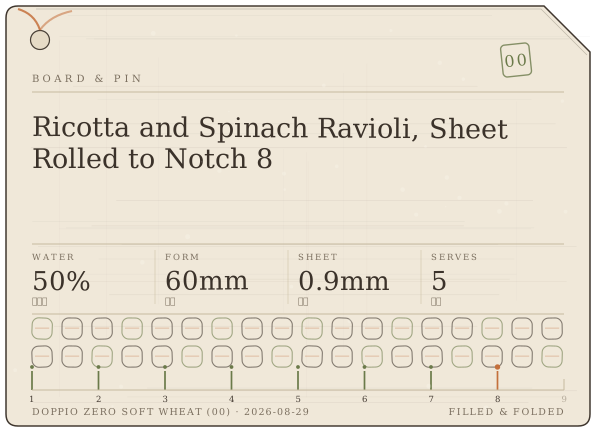
Ricotta and Spinach Ravioli, Sheet Rolled to Notch 8
里科塔菠菜饺子(ravioli),面片压到第 8 档
The sheet goes all the way to 0.9 mm — thinner than any ribbon on this site — because a filled pasta has two layers of dough and any extra thickness at the seam is a hard lump in the mouth.
Flours
Doppio Zero soft wheat (00)
Egg
Whole eggs only
Water
50%
Sheet
0.9 mm
Form
60 mm
Drying
Flat on a tray · 2h
Work
80 min + 30 min rest
Serves
5
1The ratio
Ricotta and Spinach Ravioli, Sheet Rolled to Notch 8 — 5 portions
Flour
g
baker’s %
Doppio Zero soft wheat (00)
400
100%
Egg
4 whole eggs
50%
olive oil
10
3%
salt
4
1%
Dough weight
614 g
50% Water
Per portion ≈ 123 g. Every ratio on this site is a baker’s percentage against the flour weight.
2The roller
mm
14.8 mm
24.2 mm
33.4 mm
42.6 mm
52 mm
61.6 mm
71.2 mm
80.9 mm
90.6 mm
Notch by notch1 → 2 → 3 → 4 → 5 → 6 → 7 → 8
Cut at 8 (0.9 mm) → 60 mm Form
3The filling
Spinach and ricotta
Flour
400 g spinach, blanched 40 seconds and wrung dry
350 g sheep's ricotta, drained 12 hours in a sieve
60 g parmigiano, grated
1 egg yolk
Nutmeg, grated fresh
6 g salt, black pepper
Method
Drain the ricotta overnight in a sieve over a bowl. Wet ricotta is the single reason ravioli burst.
Chop the wrung spinach fine and dry it further in a pan over low heat for 2 minutes, until it stops steaming.
Beat the ricotta with the yolk, parmigiano, salt and a good grating of nutmeg, then fold in the spinach.
Chill the filling for 30 minutes before piping. Cold filling holds its shape on the sheet.
Sauce for this
Brown butter and sage
焦化黄油鼠尾草
Brown butter and sage is thin enough to flow around the crimps and into the folds of each parcel. A thick ragù sits on top of ravioli and never reaches the seam, which is where the flavour needs to be.
Holds 4% butter
Flour
90 g cold unsalted butter, cut in four pieces
10 sage leaves, left whole
1 tbsp pasta water
20 g grated Parmigiano Reggiano
A squeeze of lemon, only if the butter is very sweet
Method
Melt the butter over medium heat with the sage leaves in it.
Wait for the foam to subside and the milk solids to turn the colour of hazelnut skin, about 4 minutes.
Pull it off the heat the moment it smells of toasted nuts; it will keep darkening in the pan.
Add the pasta water and swirl to a sauce, then the parmigiano, off the heat.
Sage goes in cold butter, not hot. Dropped into already-browning butter it turns bitter in under 30 seconds.
Why filled pasta is rolled thinner, not thicker
A 0.9 mm sheet at notch 8 gives a finished raviolo with two 0.9 mm walls around the filling, which reads as one soft parcel. At 1.6 mm the same raviolo has walls as thick as a pappardella and the seam becomes a chewy ridge around every bite.
The counter-intuitive part: the thinner sheet is also less likely to burst. Thin dough stretches with the filling as it heats; thick dough stays rigid and the seam splits.
Dry ricotta or no ravioli
Ricotta straight from the tub carries 10 to 15% free water. In a sealed raviolo that water turns to steam, the parcel inflates, and it splits along the weakest point of the crimp — always at the table, always on the last three pieces of a batch.
Drain it 12 hours in a sieve lined with paper, over a bowl, in the fridge. 350 g of tub ricotta yields about 290 g of usable cheese and leaves 60 ml of whey behind. That 60 ml is the difference between a clean batch and a pot of cloudy water with floating filling.
Piping, sealing and cutting
Pipe 12 g mounds on the first sheet at 5 cm intervals, using a piping bag with a 14 mm plain tip. A spoon gives uneven mounds and uneven mounds seal unevenly.
Brush between the mounds with beaten egg white, not yolk. White dries hard and clear; yolk stays tacky and cooks to a visible yellow stain around the seam.
Press out the air from the centre outward with the side of your hand, then cut with a fluted wheel at 60 mm. Air pockets are what make a raviolo float at the end of cooking — the moment it floats, it is full of steam and about to open.
Cooking a filled pasta
Four minutes in gently boiling water, at a bare simmer. A hard boil tosses the ravioli against each other and the crimps tear.
Cook six at a time, not thirty. Crowding drops the water temperature, the pasta sits in warm water, and the sheets go gluey before the filling is hot.
Drying
Lay the ravioli on a tray dusted with semolina, 2 cm apart, and stand the tray in front of a fan.
Turn them after 1 hour; the underside is always the wet side.
Two hours total is right for cooking today, or freeze at the 90-minute mark on the tray, then bag.
Frozen ravioli go straight into boiling water; never thaw them first or the sheets collapse.
Keeping Fresh ravioli keep 48 hours in the fridge on a cloth-covered tray. Frozen they hold three months, but freeze them on the tray first: bagged while soft, they weld into one block and thaw into a single sheet of dough.
When it goes wrong
Ravioli burst in the pot
Because Wet ricotta steaming inside a sealed parcel.
Do this Drain the ricotta 12 hours. For this batch, drop the cooking time to 3 minutes and serve them in a shallow dish so any escape is at least contained.
Seams open in the water
Because Flour on the sealing surface, or air left inside the parcel.
Do this Brush flour off with a dry pastry brush before egg-washing, and press from the centre outward.
Filling tastes watery
Because Spinach not dried after wringing.
Do this Two minutes in a dry pan over low heat. The spinach should squeak against the spoon before it goes into the ricotta.
 Board & Pin