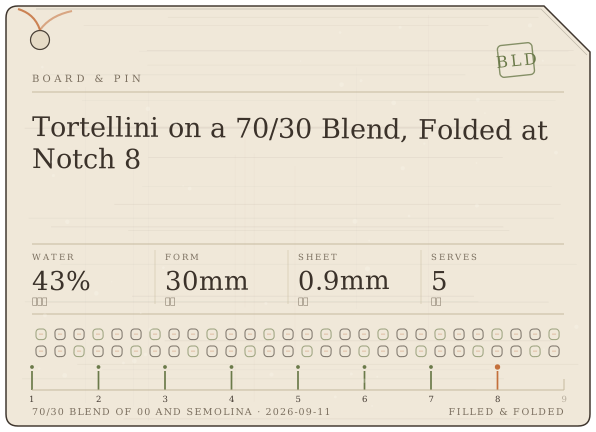
Tortellini are the tightest fold in the repertoire: a 30 mm square of 0.9 mm sheet, one 6 g bead of filling, and a lock that has to survive six minutes in broth without a single one opening.
Flours
70/30 blend of 00 and semolina
Egg
Yolks plus a whole egg
Water
43%
Sheet
0.9 mm
Form
30 mm
Drying
Flat on a tray · 2h
Work
95 min + 40 min rest
Serves
5
1The ratio
Tortellini on a 70/30 Blend, Folded at Notch 8 — 5 portions
Flour
g
baker’s %
Doppio Zero soft wheat (00)
280
70%
Durum semolina, rimacinata
120
30%
Egg
6 yolks + 1 whole eggs
43%
water
20
5%
olive oil
10
3%
salt
4
1%
Dough weight
586 g
43% Water
Per portion ≈ 117 g. Every ratio on this site is a baker’s percentage against the flour weight.
2The roller
mm
14.8 mm
24.2 mm
33.4 mm
42.6 mm
52 mm
61.6 mm
71.2 mm
80.9 mm
90.6 mm
Notch by notch1 → 2 → 3 → 4 → 5 → 6 → 7 → 8
Cut at 8 (0.9 mm) → 30 mm Form
3The filling
Porcini, prosciutto and ricotta
Flour
30 g dried porcini, soaked 30 minutes in 200 ml warm water
120 g prosciutto crudo, minced
200 g cow's ricotta, drained
50 g parmigiano, grated
1 shallot, 20 g butter
Nutmeg, black pepper, 5 g salt
Method
Squeeze the porcini dry, chop fine, and fry with the shallot in butter for 4 minutes until the mixture is dry and squeaky.
Cool completely. Warm filling sweats on the sheet and the seal will not hold.
Beat the ricotta with the parmigiano, salt, nutmeg and pepper, then fold in the porcini and the minced prosciutto.
Rest the filling 30 minutes in the fridge so the fat re-solidifies and the mounds hold their shape.
Sauce for this
Porcini cream with prosciutto
牛肝菌奶油配生火腿
Porcini cream is thick and coats each parcel rather than pooling between them. A thin sauce would drain off the fold and leave you eating plain dough at the navel.
Holds 4% mushroom
Flour
30 g dried porcini, soaked 30 minutes in 300 ml warm water
80 g prosciutto crudo, cut in ribbons
1 shallot, 30 g butter
150 ml double cream
50 ml dry marsala
40 g parmigiano
Method
Lift the porcini out of the soaking liquid; strain the liquid through a paper towel and keep it.
Cook the shallot in butter, add the prosciutto and the porcini, and fry 3 minutes.
Add the marsala and reduce to a syrup, then the strained porcini water. Reduce by half.
Add the cream and reduce until it coats the back of a spoon. Off the heat, add the parmigiano.
Filter the soaking water. The grit that settles at the bottom of the bowl is what makes a porcini sauce taste of soil in the bad way.
Why the blend, and why six yolks
Tortellini are handled twice — cut, filled, folded, then turned around a finger — and every handling step stretches the sheet. The 30% semolina in this blend gives the sheet the memory to spring back into shape instead of staying stretched where your thumb left it.
The six yolks on top of one whole egg push the yolk share to 67%. That is deliberate: yolk-rich dough is more plastic at 0.9 mm, which is exactly what a fold this small needs.
Cutting squares, not circles
Cut the sheet into 30 mm squares with a wheel. Squares give four 30 mm seams that meet at predictable corners; circles of the same area give a long curved seam that is harder to seal evenly by hand.
Stack the squares under a damp cloth and work in batches of twelve. A 0.9 mm square dries to a brittle chip in under four minutes in a normal kitchen.
The fold, in four movements
Place 6 g of filling on the lower half, fold to a triangle, and press the long edge only. Leave the two pointed ends open at this stage.
Pick the triangle up, push your index finger into the middle of the filled part so the filling is cradled, and bring the two points together behind the finger. Overlap them by 4 mm and pinch.
Turn the finished ring so the seam faces down and the navel faces up. A tortellino looks like a small belly button, and that navel only appears if the finger was in the right place.
Aim for 40 pieces per 400 g of flour. Anything under 30 and the fold is too loose; the filling will not be enclosed by dough on all sides.
Cooking in broth, not in water
Tortellini are traditionally cooked in capon broth and served in it. If you cook them in water, the filling loses its seasoning to the pot through the seam, which is thin by necessity.
Five minutes in broth held at 90 °C. Above that the parcels knock against each other and the points untuck.
Drying
Set the finished tortellini on a semolina-dusted tray with the navel up.
Air-dry 2 hours before cooking; this sets the fold so it does not untuck in the pot.
Turn them once at the 1-hour mark, gently, with a fish slice rather than your fingers.
For freezing, freeze on the tray then bag; a frozen tortellino holds its fold better than a fresh one.
Keeping Two days in the fridge, three months frozen. Cooked tortellini cannot be kept at all — the fold opens and the filling leaks within an hour of draining.
When it goes wrong
Points come untucked in the pot
Because The overlap was less than 4 mm, or the dough was not air-dried before cooking.
Do this Press the points together with a 4 mm overlap and let them sit 2 hours. Nudge the overlap wider with a fingertip before cooking; you can re-pinch a raw tortellino, never a cooked one.
Navel is flat, not dimpled
Because Your finger was not deep enough in the filling when the points came round.
Do this Push the index finger in until you feel the filling move aside, then bring the points round behind it.
Filling tastes raw
Because The porcini were not fried dry enough, so the mixture still carries soaking water.
Do this Fry until the pan is dry and the mushrooms squeak. Cool before it meets the ricotta.
 Board & Pin