

Skip to the dough cards
Board & Pin
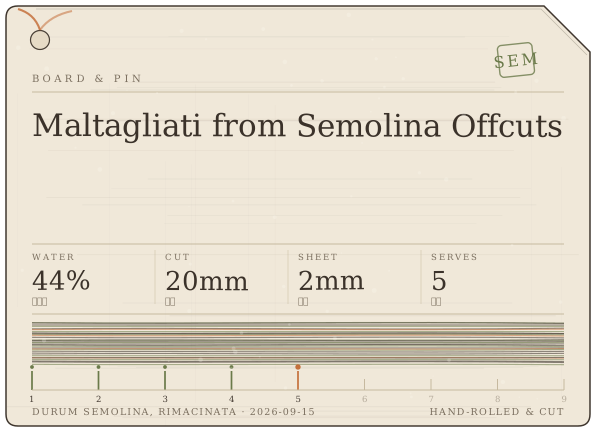
Maltagliati from Semolina Offcuts

Hand-Rolled & Cut · Starting point

Maltagliati from Semolina Offcuts

硬粒小麦碎面(maltagliati),用边角料做

Maltagliati means badly cut, and that is the whole technique: the trimmings from a sheet of semolina dough, slashed into 20 mm shards at whatever angle the knife happens to land.

Flours
Durum semolina, rimacinata
Egg
Water only, no egg
Water
44%
Sheet
2 mm
Cut
20 mm
Drying
Hung on a dowel · 8h
Work
40 min + 30 min rest
Serves
5

1The ratio

portions
Maltagliati from Semolina Offcuts — 5 portions
Flourgbaker’s %
Durum semolina, rimacinata400100%
Eggno egg44%
water17644%
olive oil82%
salt41%
Dough weight588 g44% Water

Per portion ≈ 118 g. Every ratio on this site is a baker’s percentage against the flour weight.

2The roller

2mm
  1. 14.8 mm
  2. 24.2 mm
  3. 33.4 mm
  4. 42.6 mm
  5. 52 mm
  6. 61.6 mm
  7. 71.2 mm
  8. 80.9 mm
  9. 90.6 mm

Notch by notch 1 → 2 → 3 → 4 → 5

Cut at 5 (2 mm) → 20 mm Cut

Sauce for this

Chickpea and tomato

鹰嘴豆番茄

Chickpea and tomato is a sauce that needs help thickening, and maltagliati is the only shape here that provides it from the inside. Cook the two together, not separately.

Holds 5% vegetable

Flour

  • 250 g cooked chickpeas, half of them mashed
  • 400 g tinned tomatoes
  • 1 rosemary sprig, 2 garlic cloves
  • 5 tbsp olive oil
  • 1 tsp smoked paprika
  • 80 ml pasta water

Method

  1. Fry the garlic and rosemary in oil over low heat for 5 minutes, then remove the rosemary.
  2. Add the paprika and stir for 20 seconds, no longer, or it turns bitter.
  3. Add the tomatoes and chickpeas, mashing a third of them against the side of the pan to thicken the sauce.
  4. Simmer 15 minutes, then loosen with pasta water.

Mashing part of the chickpeas is what makes the sauce cling. Whole chickpeas alone slide straight off a semolina noodle.

A shape defined by its irregularity

Every other shape in this collection has a target dimension. Maltagliati has only a range: shards between 15 and 25 mm, three-sided and four-sided mixed, cut at angles between 30 and 60 degrees. Within an hour of cooking they self-thicken the sauce because the shards break down at their thin points.

This is the reason maltagliati is paired with pulses in every region of Italy that makes it. The starch from the broken edges is what turns a thin chickpea broth into something that coats a spoon.

The 2 mm sheet is deliberate

At notch 5 the sheet is 2.0 mm — thicker than a tagliatelle and thinner than a pappardella. Thinner and the shards dissolve into the sauce; thicker and they stay chalky in the middle even after ten minutes.

Cut with a wheel or a knife, straight down and diagonally across the sheet in alternating directions, until the whole sheet is a pile of shards. Do not sort them. The mixture of sizes is the recipe.

Drying flat, not hung

Twenty millimetre shards cannot be hung; they slide off a dowel. Spread them on a cloth in a single layer for 8 hours instead, turning them once at the halfway point.

Partially dried maltagliati (4 hours) behaves quite differently from fully dried (8 hours): the partially dried ones thicken the sauce more because their edges break down faster. If you want a thicker result, cook them the same day.

Cooking with the chickpeas

Drop the maltagliati into the simmering chickpea sauce itself, not into a pot of water, with an extra 300 ml of water. Ten minutes, stirring twice so nothing catches on the bottom.

This is the one shape on the site that is cooked in its sauce. It works because maltagliati releases so much starch, and it means the sauce thickens to a stew-like consistency that a boiled-and-drained noodle could never produce.
Drying

  1. Spread the shards in a single layer on a cloth, not on a tray with a rim.
  2. Dry 8 hours, turning once at 4 hours with your hand, not a spoon.
  3. Shards are dry when they snap rather than bend; they will still feel slightly rough on the cut edges.
  4. Store flat in a shallow box, not in a bag, so the shards do not compact.

Keeping Three weeks in a shallow box lined with paper. Do not bag them: shards packed tight rub against each other and shed the very edges that do the thickening.

When it goes wrong

Sauce stays thin
Because The maltagliati were drained and added at the end instead of cooked in the sauce.
Do this Cook them in the sauce with extra water. The starch needs to be in the pan, not down the sink.
Shards stick together in the box
Because Stored before they were fully dry, or packed in a bag.
Do this Dry to 8 hours and store flat with paper between layers.
Shards taste chalky in the middle
Because Sheet rolled below 1.6 mm at the thin end, so the thin ones overcooked and the thick ones undercooked unevenly.
Do this Keep the whole sheet at notch 5, 2.0 mm, and cut your shards from a single uniform sheet.

Also on the bench