Board & Pin


Wringing is the whole recipe
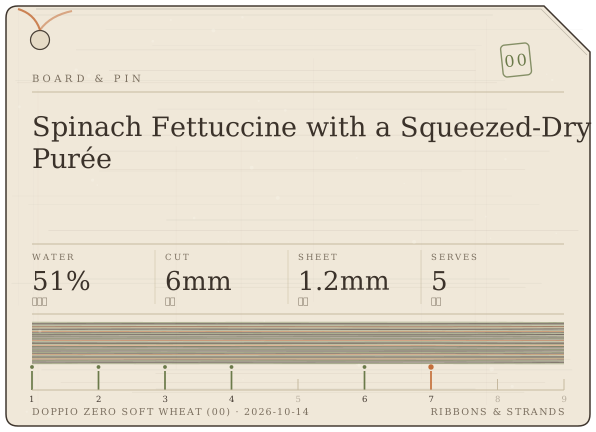
Blanch 250 g of spinach for 40 seconds, shock it in ice water, then squeeze it in a clean tea towel until the cloth stops showing green. You will be left with roughly 55 g of dry-ish purée from 250 g of leaves — a five-to-one reduction that most recipes quietly leave out.
If the purée is wet, the dough needs 60 g of extra flour to reach the same consistency, the spinach percentage drops by a fifth, and the colour fades from deep green to a tired olive.
Working the purée into the flour
Whisk the purée into the beaten eggs first, then add the mixture to the flour well. Adding purée directly to the flour gives you green lumps that never fully break down, and those lumps become weak points in the sheet at notch 6.
The dough should be a uniform deep green with no marbling. If you can still see darker specks, knead another two minutes before resting it.
Rolling green dough
Spinach dough is slightly more fragile than plain 00, so the sequence skips notch 5 and goes 1 - 2 - 3 - 4 - 6 - 7. Skipping a middle notch keeps the sheet moving rather than letting it sit and take on moisture from the air.
Watch for a pale halo at the edges of the sheet from notch 6 onward. That halo means the purée was not evenly dispersed and the outer 5 mm has less vegetable matter than the centre; trim it off rather than letting it become a brittle edge on every strand.
Cooking and keeping the colour
Two and a half minutes in well-salted water. Chlorophyll is heat-sensitive, and past three minutes the green turns dull brown no matter what you do afterwards.
Do not add lemon juice or vinegar to the water hoping to fix the colour. Acid turns chlorophyll grey-olive by a different route. The only reliable way to keep green pasta green is to cook it briefly and sauce it immediately.