

Skip to the dough cards
Board & Pin
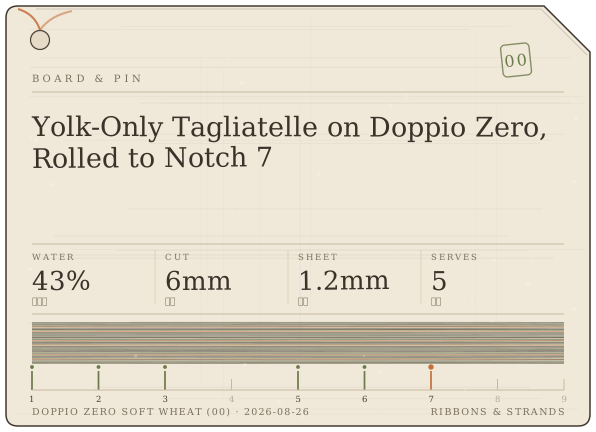
Yolk-Only Tagliatelle on Doppio Zero, Rolled to Notch 7

Ribbons & Strands · Core

Yolk-Only Tagliatelle on Doppio Zero, Rolled to Notch 7

纯蛋黄 00 号塔利亚泰莱,压到第 7 档

Ten yolks and 400 g of 00, no water anywhere in the bowl. The sheet is taken down to 1.2 mm on notch 7 and cut 6 mm wide — the widest ribbon that still behaves when it is tossed with a heavy ragù.

Flours
Doppio Zero soft wheat (00)
Egg
Yolks only
Water
43%
Sheet
1.2 mm
Cut
6 mm
Drying
Coiled into a nest · 18h
Work
50 min + 30 min rest
Serves
5

1The ratio

portions
Yolk-Only Tagliatelle on Doppio Zero, Rolled to Notch 7 — 5 portions
Flourgbaker’s %
Doppio Zero soft wheat (00)400100%
Egg10 yolks43%
olive oil123%
salt41%
Dough weight586 g43% Water

Per portion ≈ 117 g. Every ratio on this site is a baker’s percentage against the flour weight.

2The roller

1.2mm
  1. 14.8 mm
  2. 24.2 mm
  3. 33.4 mm
  4. 42.6 mm
  5. 52 mm
  6. 61.6 mm
  7. 71.2 mm
  8. 80.9 mm
  9. 90.6 mm

Notch by notch 1 → 2 → 3 → 5 → 6 → 7

Cut at 7 (1.2 mm) → 6 mm Cut

Sauce for this

Bolognese ragù (slow, milk-finished)

博洛尼亚肉酱(慢炖、以牛奶收尾)

Bolognese delivers about 250 g of sauce per portion. That weight needs a ribbon 6 mm wide with a rough, egg-rich surface to hold on to, which is why this sheet takes the heaviest ragù on the site and the thin tagliolini does not.

Holds 6% meat

Flour

  • 250 g coarse-ground beef chuck
  • 120 g pancetta, minced
  • 1 small onion, 1 carrot, 1 celery rib, all minced fine
  • 150 ml dry white wine
  • 200 ml whole milk
  • 400 g passata
  • 30 g tomato paste, 2 tbsp olive oil

Method

  1. Soften the soffritto in oil over low heat for 12 minutes until it is sweet and no longer smells raw.
  2. Add the pancetta, then the beef. Brown it hard without stirring for the first 4 minutes so it crusts.
  3. Deglaze with the wine and let it evaporate completely, about 3 minutes.
  4. Add the milk and reduce until it has almost vanished, then the passata and paste. Simmer uncovered at the barest bubble for 3 hours.

The milk is not a cream substitute; its proteins and lactose coat the meat fibres and keep the ragù from tasting sharp after a long simmer.

Why ten yolks and not a drop of water

Water dilutes the two things that make an egg ribbon worth the trouble: lecithin and pigment. Ten large yolks weigh about 170 g against 400 g of flour, which puts the dough at 43% hydration — low enough that the sheet stays stiff on the roller and never needs a second dusting.

The lecithin in the yolk also shortens the gluten. That sounds like a defect and is exactly the point: a shortened gluten network rolls thin without springing back, so the ribbon keeps the 6 mm width you cut it to instead of shrinking to 4 mm in the water.

Mixing on the board, then resting

Tip the 00 into a mound, make a well wide enough for your whole hand, and slide the yolks in with the oil and salt. Work the flour in from the inside wall with two fingers, never breaking the outer ring until the last third of the flour has been taken up. The dough is shaggy and looks wrong for about four minutes.

Knead eight minutes until the surface is smooth but the dough still feels like cold clay. Wrap it in film and rest 30 minutes at room temperature. If you skip the rest the sheet will recoil at notch 5 and the ribbons will curl into tubes as they dry.

The rolling sequence, and why 4 is skipped

Go 1 - 2 - 3, then jump to 5, then 6, then 7. Notch 4 adds nothing between 3.4 mm and 2.0 mm except another pass that warms the sheet; skipping it keeps the dough cold, which is the only thing standing between you and a sticky roller.

Dust with semolina, not with 00. Semolina grains are angular and roll out from under the sheet; 00 packs down and turns to glue in the rollers. Cut at notch 7 for a 1.2 mm sheet and a 6 mm ribbon.

Cooking and finishing

Use 1.5 litres of water per 100 g of pasta and salt it at 10 g per litre. Fresh egg tagliatelle needs three minutes, no more; at four minutes the yolk flavour flattens and the ribbon goes limp.

Pull the pasta out 30 seconds early and finish it in the ragù pan with 60 ml of the cooking water. The starch in that water is what binds the sauce to the ribbon, and it is the difference between tagliatelle al ragù and noodles with sauce on top.
Drying

  1. Dust the ribbons with semolina and shake off the excess over the board.
  2. Coil 80 g into a loose nest about 7 cm across; do not press it down.
  3. Stand the nests on a tray lined with a clean cloth for 18 hours at room temperature, turning each one once after 6 hours.
  4. A nest is dry when the outer coil snaps cleanly and the inner coil still gives slightly.

Keeping Nests keep three weeks in a paper bag at room temperature. A sealed jar is the wrong container: the trapped moisture softens the outer coils and they fuse into a single lump within four days.

When it goes wrong

Sheet tears at notch 6
Because Dough was not rested, so the gluten is still tight and the roller is stretching it faster than it can relax.
Do this Re-wrap and rest 20 more minutes. If it still tears, work 10 g of yolk in and rest again.
Ribbons fuse inside the nest
Because Not enough semolina between the strands, or the nest was coiled while the pasta was still damp.
Do this Uncoil, dust properly and re-nest on a fresh cloth. Never dry a nest on a non-stick tray; the trapped steam has nowhere to go.
Ribbons taste flat and look grey
Because Overcooked. Yolk pigment fades above four minutes of hard boiling.
Do this Taste at 2 minutes 30 seconds, not at 4 minutes. Finish in the sauce, not in the water.

Also on the bench