

Skip to the dough cards
Board & Pin
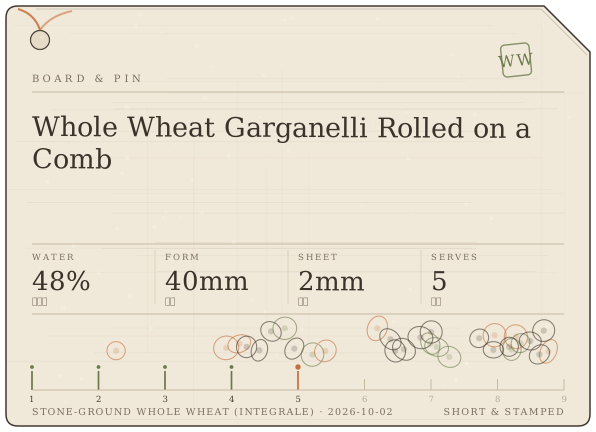
Whole Wheat Garganelli Rolled on a Comb

Short & Stamped · Demanding

Whole Wheat Garganelli Rolled on a Comb

全麦 garganelli,在梳板上搓成

A 40 mm square of 2.0 mm sheet, rolled around a dowel and dragged across a comb — a technique that gives every piece a ridged outer face and a hollow centre that catches ragù.

Flours
Stone-ground whole wheat (integrale)
Egg
Whole eggs and water
Water
48%
Sheet
2 mm
Form
40 mm
Drying
Flat on a tray · 12h
Work
70 min + 40 min rest
Serves
5

1The ratio

portions
Whole Wheat Garganelli Rolled on a Comb — 5 portions
Flourgbaker’s %
Stone-ground whole wheat (integrale)20050%
Doppio Zero soft wheat (00)20050%
Egg3 whole eggs48%
water4010%
olive oil103%
salt41%
Dough weight604 g48% Water

Per portion ≈ 121 g. Every ratio on this site is a baker’s percentage against the flour weight.

2The roller

2mm
  1. 14.8 mm
  2. 24.2 mm
  3. 33.4 mm
  4. 42.6 mm
  5. 52 mm
  6. 61.6 mm
  7. 71.2 mm
  8. 80.9 mm
  9. 90.6 mm

Notch by notch 1 → 2 → 3 → 4 → 5

Cut at 5 (2 mm) → 40 mm Form

Sauce for this

Bolognese ragù (slow, milk-finished)

博洛尼亚肉酱(慢炖、以牛奶收尾)

Bolognese is the classic pairing for garganelli, and the reason is mechanical: the ridges hold meat, and the hollow centre stays filled between the ridges, so every forkful carries sauce.

Holds 6% meat

Flour

  • 250 g coarse-ground beef chuck
  • 120 g pancetta, minced
  • 1 small onion, 1 carrot, 1 celery rib, all minced fine
  • 150 ml dry white wine
  • 200 ml whole milk
  • 400 g passata
  • 30 g tomato paste, 2 tbsp olive oil

Method

  1. Soften the soffritto in oil over low heat for 12 minutes until it is sweet and no longer smells raw.
  2. Add the pancetta, then the beef. Brown it hard without stirring for the first 4 minutes so it crusts.
  3. Deglaze with the wine and let it evaporate completely, about 3 minutes.
  4. Add the milk and reduce until it has almost vanished, then the passata and paste. Simmer uncovered at the barest bubble for 3 hours.

The milk is not a cream substitute; its proteins and lactose coat the meat fibres and keep the ragù from tasting sharp after a long simmer.

Why half whole wheat is the right ceiling here

Garganelli are rolled twice: once by the pin, once around the dowel. Two rollings on a 100% whole wheat sheet will crack it along the bran lines. At 50% whole wheat against 50% 00 there is still enough extensibility to survive the second rolling, and the bran still gives the noodle a visible speckle and a nutty edge.

The rest is 40 minutes, longer than a plain 00 dough, because bran takes that long to hydrate fully. Under-rested whole wheat dough cracks at the dowel stage, not at the roller.

Cutting squares on the diagonal

Cut the sheet into 40 mm squares with a wheel. Work on the diagonal across the sheet rather than in a grid, so that every square has at least two edges that are already straight from the sheet's edge.

Keep the squares in a single layer under a cloth. Stacked, they weld; at 2.0 mm and 50% whole wheat, they weld within two minutes.

The comb, and what it actually does

A garganelli comb is a wooden board with 5 mm grooves. Lay a square over the dowel, press the leading edge down with your thumb, and roll the dowel away from you so the square wraps and the comb presses ridges into the outer face.

The ridges are not decoration. They triple the surface area of the finished piece, which is why garganelli can carry a meat ragù that would slide straight off a smooth tube of the same size. If you have no comb, the back of a wide-toothed wooden fork works, with a coarser ridge.

Drying and cooking

Dry 12 hours on a cloth-lined tray, seam side down so the tube does not unroll. Garganelli hold their shape better than any other hand-formed shape here because the ridges lock the roll.

Cook 7 minutes. The doubled wall of a rolled garganello takes longer than a flat noodle of the same thickness, and the hollow centre stays cooler than the outside.
Drying

  1. Tray seam side down on a cloth, 1 cm apart, so the tube cannot unroll.
  2. Dry 12 hours; the ridges hold the shape so they need less time than orecchiette.
  3. Freeze at 8 hours if you want to keep them longer than a week; whole wheat goes stale faster than semolina.
  4. Dried garganelli should feel like small wooden beads, not like paper.

Keeping Two weeks in paper. Whole wheat carries the germ, and the germ carries oil, so this shape has the shortest dry shelf life of the wheat-based shapes here — semolina orecchiette last twice as long.

When it goes wrong

Squares crack when rolled on the dowel
Because Under-rested whole wheat dough, or the sheet was rolled below 2.0 mm.
Do this Rest the full 40 minutes and stay at notch 5. A 1.6 mm whole wheat sheet will crack on the dowel every time.
Tubes unroll while drying
Because Rolled without pinching the leading edge down first.
Do this Press the leading edge with your thumb before rolling. Set them down seam side down and do not move the tray for 4 hours.
Noodles taste dry and papery after a fortnight
Because Whole wheat germ oil going stale.
Do this Freeze half the batch at 8 hours. This shape keeps far better frozen than dried.

Also on the bench