Board & Pin


A 55% dough that is barely workable
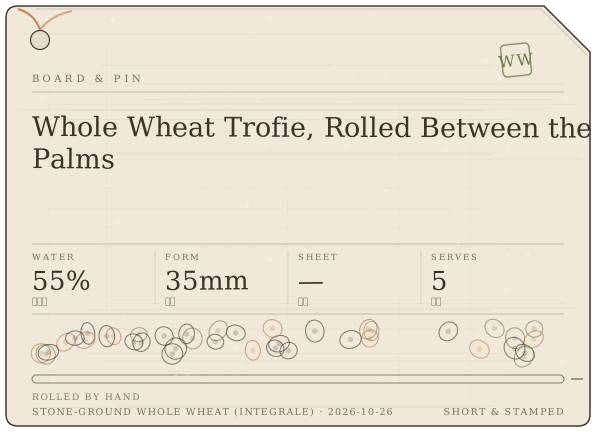
Whole wheat at 300 g and semolina at 100 g against 220 g of water is 55% hydration, which produces a dough that sticks to your palm for the first ten minutes of shaping and then stops. That window is real and it is short: work the whole batch inside twenty minutes of taking it out of the rest.
The semolina is there to keep the surface from becoming tacky. Without it, a 100% whole wheat trofie dough at 55% cannot be rolled off the palm at all — the rope simply smears.
Tear, do not cut
Roll a 6 mm rope, then tear it into 35 mm lengths with your fingers. Tearing leaves a slightly tapered end that catches the palm during rolling and produces a spindle with a pointed tip at each end — which is what gives trofie their shape.
Cut ends are blunt and roll into cylinders. This is one of the few shapes where the difference is visible on the plate.
The palm roll
Put a length in the centre of your left palm, cover it with the heel of your right palm, and roll downward once, firmly, letting the piece run out from under your hand. One stroke, not two, or it turns into a rope again.
Aim for 35 mm long and about 8 mm at the thickest point of the twist. They should look slightly irregular; perfectly uniform trofie were made by a machine and behave like it in the pot.
Drying and the pesto problem
Dry 24 hours on a cloth. Trofie are thin and dry fast, but the twist traps moisture in its centre, so do not shorten this to 12 hours even though the pieces feel dry.
Whole wheat and pesto is a deliberate pairing of two strong flavours. Boil the trofie in only 1.2 litres of water — the extra starch that builds up is the only thing that makes a raw, uncooked pesto cling to a whole wheat noodle.