Board & Pin


Why the knife beats the cutter here
A machine cutter shears the sheet into strips with two parallel flat faces. A knife cuts at a slight angle and leaves a compressed, ragged edge that swells in the pot and traps broth against the noodle.
The inconsistency is the point. Strips between 3.5 and 4.5 mm cook at marginally different rates, so a bowlful has both a firm bite and a soft one. That variation is what makes hand-cut noodles read as handmade.
A dough that can be handled without flour
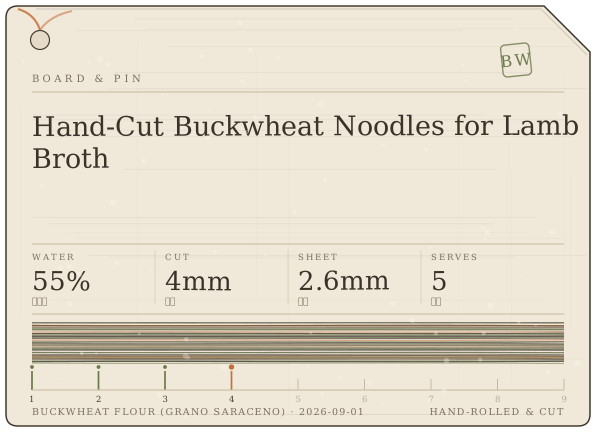
160 g of buckwheat against 240 g of semolina rimacinata, at 55% hydration, gives a dough soft enough to roll by hand but firm enough not to stick to the board. Do not dust during rolling: extra flour on a hand-cut noodle turns into a pasty film in the broth.
Use a long dowel rather than a short pin. A 60 cm dowel lets you roll from the centre outward with both hands and keep the sheet an even thickness across its width, which a short pin cannot do.
Folding and cutting
Dust the sheet lightly with buckwheat flour — not with 00 — then fold it into a 6 cm wide flat roll, three folds, with the dusted side inward.
Cut at 4 mm intervals with a heavy knife in single strokes. Rocking the blade back and forth compresses the fold and the strips stick together at the crease.
Unfold each strip immediately and toss it loosely on the board. Strips left folded for even two minutes weld at the fold line and tear when you separate them.
Cooking to order
Fresh hand-cut noodles cook in 90 seconds in plenty of water; the broth goes in the bowl, not the pot. Cooking them in the broth is the common mistake — they release starch and turn a clear lamb broth cloudy and thick within one batch.
Serve immediately. These noodles keep absorbing liquid for three minutes after they leave the pot, and a bowl left standing becomes a solid mass.