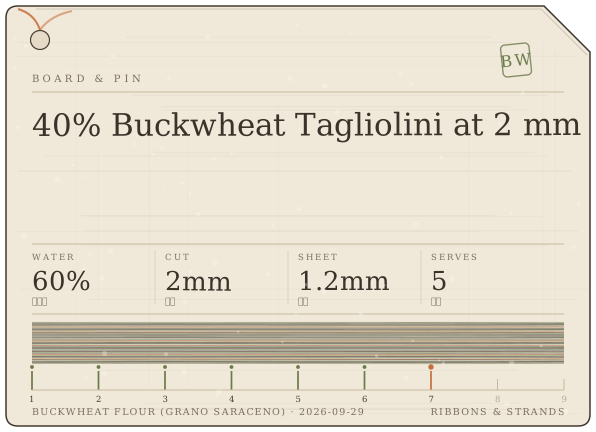
Buckwheat at 40% of the total flour weight is the ceiling before the sheet stops holding together. The reward is a 2 mm noodle, rolled to notch 7 and nested, with an earthy edge that stands up to brown butter and fried sage.
Flours
Buckwheat flour (grano saraceno)
Egg
Whole eggs and water
Water
60%
Sheet
1.2 mm
Cut
2 mm
Drying
Coiled into a nest · 12h
Work
55 min + 20 min rest
Serves
5
1The ratio
40% Buckwheat Tagliolini at 2 mm — 5 portions
Flour
g
baker’s %
Buckwheat flour (grano saraceno)
160
40%
Doppio Zero soft wheat (00)
240
60%
Egg
4 whole eggs
60%
water
40
10%
olive oil
14
4%
salt
4
1%
Dough weight
658 g
60% Water
Per portion ≈ 132 g. Every ratio on this site is a baker’s percentage against the flour weight.
2The roller
mm
14.8 mm
24.2 mm
33.4 mm
42.6 mm
52 mm
61.6 mm
71.2 mm
80.9 mm
90.6 mm
Notch by notch1 → 2 → 3 → 4 → 5 → 6 → 7
Cut at 7 (1.2 mm) → 2 mm Cut
Sauce for this
Brown butter and sage
焦化黄油鼠尾草
Brown butter and sage is a fat-forward sauce with almost no acid. It flatters the toasted, slightly bitter edge of buckwheat instead of fighting it, which a tomato sauce would.
Holds 4% butter
Flour
90 g cold unsalted butter, cut in four pieces
10 sage leaves, left whole
1 tbsp pasta water
20 g grated Parmigiano Reggiano
A squeeze of lemon, only if the butter is very sweet
Method
Melt the butter over medium heat with the sage leaves in it.
Wait for the foam to subside and the milk solids to turn the colour of hazelnut skin, about 4 minutes.
Pull it off the heat the moment it smells of toasted nuts; it will keep darkening in the pan.
Add the pasta water and swirl to a sauce, then the parmigiano, off the heat.
Sage goes in cold butter, not hot. Dropped into already-browning butter it turns bitter in under 30 seconds.
Finding the ceiling of a gluten-free flour
Buckwheat is a seed, not a wheat. It brings flavour, a grey-violet colour and zero gluten, so every point of it you add dilutes the network that holds the sheet together. At 160 g of buckwheat against 240 g of 00 you are at 40% — right at the edge, and it works only because four whole eggs supply enough protein to bridge the gap.
Go to 50% and the sheet will roll but not cut: the strands feather at the edges and fuse the moment they touch water.
60% hydration is not a typo
Buckwheat absorbs roughly a third more water than 00 for the same weight, and it keeps drinking for the first fifteen minutes. The dough will feel wetter than a wheat dough at the same percentage and will still firm up during the rest.
Add the 40 g of water in two additions after the eggs are in. If you dump it all at once the dough turns to batter and you will be adding flour, which throws off the buckwheat ratio you just measured.
Rolling a brittle sheet
Buckwheat sheets crack at the edge before they crack in the middle, so watch the edges at notch 5 and 6. Run the full sequence 1 through 7 — do not skip a notch here, because this dough needs the gradual reduction to avoid stress fractures.
Rest only 20 minutes. Buckwheat has no gluten to relax, so a long rest buys nothing and lets the dough dry at the surface, which makes it crumbly rather than extensible.
Cooking and the grey water
Cook 90 seconds. Buckwheat noodles go from al dente to mush in about forty seconds, so stay at the pot.
The cooking water turns grey-violet and tastes strongly of the grain. Reserve 80 ml of it for the brown butter: that colour and flavour are the whole reason this noodle exists, and throwing them away wastes the flour.
Drying
Dust with semolina and nest 70 g at a time — buckwheat nests are more fragile than wheat ones.
Dry 12 hours, turning at hour 4 and hour 8.
Do not hang buckwheat tagliolini: the strands are too weak and will snap under their own weight.
A dry nest smells of toasted grain; if it smells of damp cardboard, it needs another four hours.
Keeping Two weeks in a paper bag, no longer. The fat in buckwheat goes stale faster than the starch in wheat, and a four-week-old buckwheat nest tastes of old oil no matter how well it was dried.
When it goes wrong
Strands feather and break at the cut
Because Too much buckwheat, or the dough sat uncovered and dried at the surface.
Do this Dust the sheet with semolina right before cutting and cut within 60 seconds of the final pass.
Noodles taste bitter
Because Buckwheat flour was old; its oils go rancid in about ten weeks.
Do this Smell the flour before you start. Fresh buckwheat smells of hay and toasted bread; rancid flour smells of crayons.
Nests crumble on the tray
Because Over-dried at hour 8 and beyond.
Do this Pull them at 10 hours if the room is warm. Crumbled nests can still be cooked as broken noodles.
 Board & Pin