

Skip to the dough cards
Board & Pin
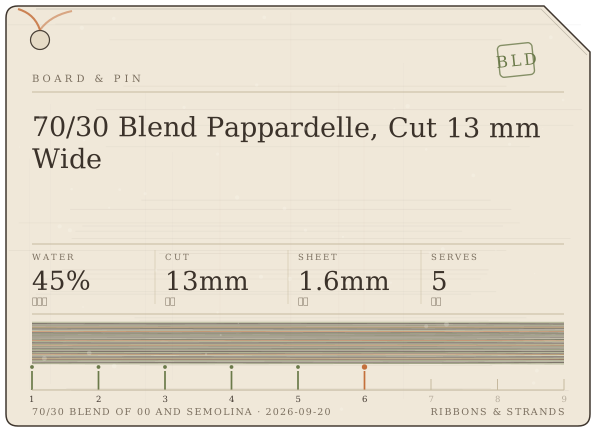
70/30 Blend Pappardelle, Cut 13 mm Wide

Ribbons & Strands · Demanding

70/30 Blend Pappardelle, Cut 13 mm Wide

70/30 拼配宽面(pappardelle),切 13 毫米

280 g of 00 and 120 g of semolina rimacinata, three eggs and a splash of water. The sheet stops at notch 6 — deliberately thicker than a tagliatelle — so the 13 mm ribbons can carry a three-hour oxtail ragù without collapsing.

Flours
70/30 blend of 00 and semolina
Egg
Whole eggs and water
Water
45%
Sheet
1.6 mm
Cut
13 mm
Drying
Hung on a dowel · 10h
Work
45 min + 40 min rest
Serves
5

1The ratio

portions
70/30 Blend Pappardelle, Cut 13 mm Wide — 5 portions
Flourgbaker’s %
Doppio Zero soft wheat (00)28070%
Durum semolina, rimacinata12030%
Egg3 whole eggs45%
water308%
olive oil123%
salt41%
Dough weight596 g45% Water

Per portion ≈ 119 g. Every ratio on this site is a baker’s percentage against the flour weight.

2The roller

1.6mm
  1. 14.8 mm
  2. 24.2 mm
  3. 33.4 mm
  4. 42.6 mm
  5. 52 mm
  6. 61.6 mm
  7. 71.2 mm
  8. 80.9 mm
  9. 90.6 mm

Notch by notch 1 → 2 → 3 → 4 → 5 → 6

Cut at 6 (1.6 mm) → 13 mm Cut

Sauce for this

Oxtail ragù with gremolata

牛尾肉酱配格雷莫拉塔

Oxtail ragù is 30% collagen by weight and coats a wide ribbon like paint. The 1.6 mm sheet gives the fork something to twirl against; at 1.2 mm the same sauce reads as soup.

Holds 8% meat

Flour

  • 1.2 kg oxtail, jointed
  • 1 onion, 1 carrot, 1 celery rib, 1 leek
  • 500 ml red wine
  • 500 ml beef stock
  • 1 strip orange peel, 2 bay leaves
  • Gremolata: zest of 1 lemon, 1 garlic clove, 20 g parsley

Method

  1. Brown the oxtail on every face, 12 minutes total. Pour off all but 2 tbsp of fat.
  2. Add the vegetables and cook until they take on colour, then the wine. Reduce by half.
  3. Add stock, peel and bay. Cover and braise at 150 °C for 3.5 hours, until the meat leaves the bone with a nudge.
  4. Pull the meat, discard the bones, skim the fat, and reduce the liquid until it coats a wooden spoon.
  5. Chop the gremolata and stir it in raw, off the heat.

Oxtail gives up roughly 30% of its weight in collagen, and that collagen is why the sauce clings to a 13 mm pappardella without any flour.

Why this recipe is thicker on purpose

A wide ribbon has more surface area per gram than a narrow one, so it picks up more sauce. It also has more unsupported span, so it sags. Stopping the roller at 1.6 mm instead of 1.2 mm gives the ribbon a spine: the centre stays firm while the surface softens and grips.

Cut thinner and the pappardelle turns into a wet rag in the bottom of the bowl within two minutes of saucing. That is the single most common failure with wide ribbons.

The blend and why it matters here

Semolina at 30% raises the average W from 180 to about 205. That extra strength is what lets you rest this dough for 40 minutes — longer than any 00 dough would tolerate without going slack — and then roll it wide without a tear at the edge.

Mix the two flours dry, with your hand, for a full 30 seconds before the eggs go in. Uneven blending shows up later as pale streaks in the sheet and as one edge that rolls thinner than the other.

Rolling, dusting and the width cut

1 - 2 - 3 - 4 - 5 - 6, dusting with semolina at every other pass only. Over-dusting is a real problem with a wide sheet: the excess flour ends up in the sauce and gives it a raw, chalky edge.

Cut at 13 mm. The cutter on most home machines tops out around 6.5 mm, so use a knife and a ruler: lay the sheet on the board, trim the ends square, then cut strips at 13 mm with a single firm stroke. A sawing motion frays the edge.

Cooking a thick wide ribbon

Thirteen millimetres at 1.6 mm takes 4 to 4.5 minutes, longer than tagliatelle. Pull it 45 seconds early and finish it in the ragù with a full ladle of pasta water — a wide ribbon needs more liquid in the pan than a narrow one because more of it is out of the sauce at any moment.

Serve in warm shallow bowls, not deep ones. Pappardelle piled in a deep bowl steams itself and the ribbons weld together.
Drying

  1. Dust the ribbons with semolina and lay them flat on a cloth for 20 minutes until they stop feeling tacky.
  2. Hang them over a dowel in single layers, 13 mm side vertical, spaced 3 cm apart.
  3. Dry 10 hours in moving air; wide ribbons hold moisture in the middle long after the edges look done.
  4. A ribbon is dry when it cracks rather than bends at the fold.

Keeping Lay dried pappardelle flat between two sheets of paper in a shallow box, or hang them in bundles of ten tied with cotton string. Do not nest them: a 13 mm ribbon coiled into a nest cracks along the fold within a day.

When it goes wrong

Ribbons snap along a pale line
Because Flour streaks were never blended in, and that line has no gluten.
Do this Sift the two flours together next time. For the current batch, cook the broken ribbons as maltagliati rather than throwing them out.
Sauce slides off
Because The sheet was over-dusted and cooked in water that was too clean.
Do this Shake the ribbons hard before they go in the pot, and use 1.2 litres of water rather than 4.
One edge is thinner than the other
Because The sheet was fed into the roller at an angle.
Do this Feed it dead square, and after each pass fold the sheet in half and re-feed with the folded edge first. That evens out the thickness on both sides.

Also on the bench