Board & Pin


The twist is not decorative
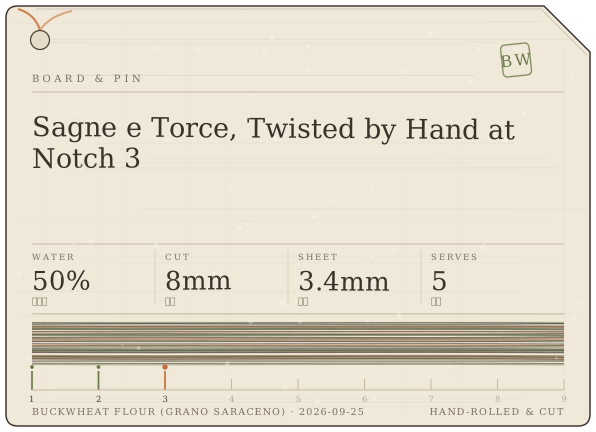
A flat 8 mm band cooks into a limp ribbon. Twisted once between the palm and the board, the same band becomes a short helix with a groove that holds sauce and a shape that keeps its bite even after eight minutes in the pot.
Twist in one direction only, from the near end away from you. Twisting back and forth makes an S-shaped noodle that untwists completely in the water.
The stiffest dough on the site
50% hydration with no egg produces a dough that fights the rolling pin for the first three minutes and then suddenly cooperates. Push through it; adding water to make the early stage easier gives you a dough that will not hold a twist and sags off the dowel.
Rest 45 minutes, the longest rest on the site. Buckwheat and semolina hydrate at different rates, and this dough needs both of them to finish before it can be rolled evenly.
Rolling thick and cutting wide
Roll 1 - 2 - 3 and stop at 3.4 mm. Below that the twist has nothing to hold: a 2 mm band twisted will simply snap at the thinnest point.
Cut the sheet into 8 mm bands with a wheel, working across the sheet rather than along it, so the bands are as long as the sheet is wide. Lift each band with a fork, not your fingers, and twist.
Cooking and the salt question
These noodles are dense. Eight minutes at a rolling boil, and they still come out firm at the core, which is correct — sagne e torce are meant to be chewed.
Because there is no egg and no fat, the water is your only chance to season them: 12 g of salt per litre rather than the usual 10. Drain and toss immediately with the sauce off the heat.