Flour, water, salt, nothing else — the Roman square-cut spaghetti at 2.5 mm, built so that the starch it sheds in the pan is thick enough to turn pecorino and pepper into a sauce without cream or butter.
Flours
Durum semolina, rimacinata
Egg
Water only, no egg
Water
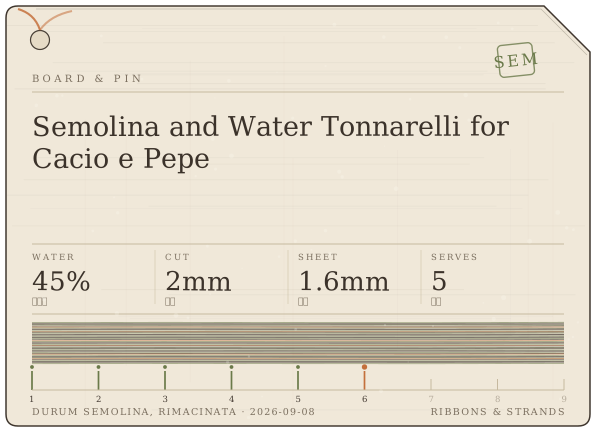
45%
Sheet
1.6 mm
Cut
2.5 mm
Drying
Hung on a dowel · 6h
Work
45 min + 30 min rest
Serves
5
1The ratio
Semolina and Water Tonnarelli for Cacio e Pepe — 5 portions
Flour
g
baker’s %
Durum semolina, rimacinata
400
100%
Egg
no egg
45%
water
180
45%
olive oil
8
2%
salt
4
1%
Dough weight
592 g
45% Water
Per portion ≈ 118 g. Every ratio on this site is a baker’s percentage against the flour weight.
2The roller
mm
14.8 mm
24.2 mm
33.4 mm
42.6 mm
52 mm
61.6 mm
71.2 mm
80.9 mm
90.6 mm
Notch by notch1 → 2 → 3 → 4 → 5 → 6
Cut at 6 (1.6 mm) → 2 mm Cut
Sauce for this
Cacio e pepe
罗马羊奶酪黑胡椒面(cacio e pepe)
Cacio e pepe has no fat other than what the cheese brings. It needs the roughest, starchiest strand on the board, and that is this one — an egg ribbon would emulsify the sauce but never thicken it.
Holds 0% cheese
Flour
120 g Pecorino Romano, finely grated on a Microplane
2 tsp black peppercorns, cracked coarse
1 tbsp butter (a modern crutch, not a Roman one)
180 ml pasta water, starchy and barely salted
Method
Toast the cracked pepper in a dry pan for 40 seconds, until it smells like a spice market.
Add the butter and 100 ml pasta water; swirl to a loose emulsion off the heat.
Off the flame entirely, rain in the pecorino while swirling. Never let it boil.
Loosen with the remaining water until it coats a spoon, then toss the pasta for 30 seconds.
Above 80 °C pecorino breaks into strings. Take the pan off the heat before the cheese goes in, and the sauce will be glossy every time.
The dough is supposed to look wrong
400 g of semolina rimacinata and 180 g of water at room temperature come together into something that resembles wet sand for the first five minutes. Do not add water. Semolina particles are irregular and take time to hydrate; the dough tightens on its own between minute five and minute eight.
Knead ten minutes in total, then rest 30 minutes wrapped. Semolina has a W of about 260, so it can take a long knead, but it also fights back harder than 00 and will tear your forearm tendons before it tears itself.
Cutting square, the Roman way
Roll 1 - 2 - 3 - 4 - 5 - 6 and stop at 1.6 mm. Tonnarelli are cut on the square-wire attachment rather than the flat cutter, which is why they read as square rods instead of flat ribbons; if your machine has only the flat cutter, cut at notch 6 and accept the compromise.
The 2.5 mm width matters more than it looks. Thinner and the strands overcook before the cheese sauce is ready; wider and the dish eats like fettuccine, which is a different plate entirely.
Why this dough holds the cheese
A tonnarelli releases roughly twice the surface starch of an egg ribbon of the same weight, because its cut faces are square and rough. That starch is what lets 120 g of pecorino emulsify into 180 ml of water without a single drop of cream.
Boil in only 1.2 litres of water for 300 g of pasta. The less water you use, the more concentrated the starch, and this whole recipe is a starch-management exercise.
Finishing in a cold pan
Take the pan off the heat before the cheese goes anywhere near it. Pecorino breaks above 80 °C, and a broken cacio e pepe cannot be rescued by stirring — the proteins have already tightened.
Work in a wide bowl rather than a skillet if you are new to it: the wider surface sheds heat faster, and you get three or four more seconds of grace between glossy and grainy.
Drying
Hang the strands over a wooden dowel or the back of a chair, spaced so no two strands touch.
Dry 6 hours in a room with moving air; a still room takes 10 and dries unevenly.
Semolina strands go from leathery to brittle with no warning, so check at hour 5.
Store straight strands in a paper bag, snapped into 20 cm lengths.
Keeping Straight-hung semolina strands keep about three weeks in paper. They take on humidity faster than egg pasta because there is no fat in the dough to slow it down, so keep them away from the stove.
When it goes wrong
Sauce turns to strings
Because The pan was too hot when the pecorino went in.
Do this There is no saving a broken batch. Start again with a cold pan and add the cheese in three additions.
Strands snap when you lift them off the dowel
Because Over-dried. Semolina goes brittle fast.
Do this Use them anyway; snapped tonnarelli cook the same. Next time check at hour 5.
Dough stays sandy no matter how long you knead
Because Too little water for the grind of your semolina, which varies by mill.
Do this Add water 5 g at a time after minute eight. The target is a dough that barely holds a thumbprint.
 Board & Pin