

Skip to the dough cards
Board & Pin
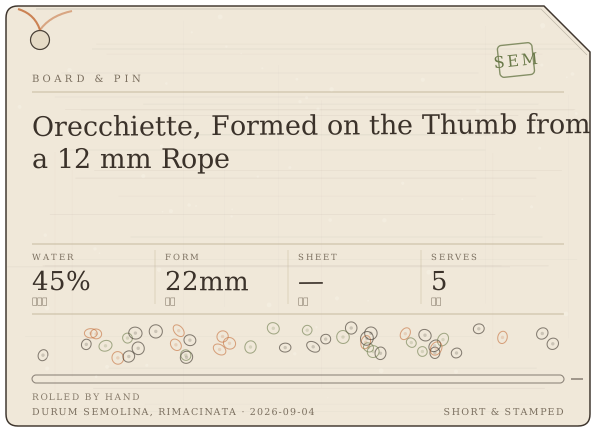
Orecchiette, Formed on the Thumb from a 12 mm Rope

Short & Stamped · Core

Orecchiette, Formed on the Thumb from a 12 mm Rope

猫耳朵(orecchiette),用手拇指从 12 毫米条搓出来

No rolling pin, no sheet, no cutter: a 12 mm rope of semolina dough is cut into 8 mm beads and each one is dragged across the board with the thumb into a 22 mm ear.

Flours
Durum semolina, rimacinata
Egg
Water only, no egg
Water
45%
Sheet
—
Form
22 mm
Drying
Flat on a tray · 24h
Work
60 min + 20 min rest
Serves
5

1The ratio

portions
Orecchiette, Formed on the Thumb from a 12 mm Rope — 5 portions
Flourgbaker’s %
Durum semolina, rimacinata400100%
Eggno egg45%
water18045%
salt41%
Dough weight584 g45% Water

Per portion ≈ 117 g. Every ratio on this site is a baker’s percentage against the flour weight.

2The roller

Rolled by hand, not through a machine — Rope diameter 22 mm, Flat on a tray.

Sauce for this

Broccoli rabe, garlic and anchovy

西兰花苔、蒜与鳀鱼

Broccoli rabe, garlic and anchovy is a sauce with whole pieces in it. The ears are designed to catch those pieces — a piece of anchovy lodges in the curl and stays there through the whole plate.

Holds 2% vegetable

Flour

  • 500 g broccoli rabe (cime di rapa), trimmed
  • 4 garlic cloves, sliced
  • 4 anchovy fillets in oil
  • 80 ml olive oil, 1 dried chilli
  • 60 g pecorino
  • 1 tsp lemon zest

Method

  1. Blanch the rabe in well-salted water for 90 seconds, then shock in cold water and squeeze dry.
  2. Melt the anchovies into the warm oil over low heat; they should dissolve, not fry.
  3. Add the garlic and chilli, then the rabe, and cook 4 minutes so it takes on the oil.
  4. Toss with the pasta and pecorino, loosening with pasta water.

Anchovies dissolve at about 60 °C. If they spit and brown, the oil is too hot and the sauce will taste of fish instead of depth.

Why this shape skips the roller entirely

An orecchietta is a solid piece of dough with a rough inner face and a smooth outer one. Rolling a sheet and cutting discs would give you a flat, even puck with two smooth sides — the opposite of what the shape is for.

The 12 mm rope is the only measurement that matters. Thinner and the ears are too small to cup sauce; thicker and they stay chalky in the middle at eight minutes.

The rope, and how to roll one that does not taper

Take 120 g of rested dough and roll it under the flat of your hand from the centre outward, moving your hand steadily toward both ends. Most people roll from the middle and stop, which produces a rope that is 14 mm in the centre and 9 mm at the ends.

You want a rope that is 12 mm for at least 40 cm of its length. Cut it into 8 mm beads and keep the beads under a cloth while you form them.

The thumb drag

Hold a bead between thumb and forefinger and drag it across a lightly floured board with the tip of your thumb, pressing at the end of the stroke so the far edge curls up. The ear forms in one movement of about 40 cm.

Turn the ear inside out over your thumb and set it down with the rough side up. The rough face — the drag marks — is what holds sauce. Setting them smooth-side-up gives you a bowl of ear-shaped dough with sauce running around it.

Aim for 90 to 100 orecchiette from 400 g of flour. That works out to roughly one every four seconds once you find the rhythm.

Drying them properly

Twenty-four hours on a cloth-lined tray, rough side up, without turning. The ears harden into a shell that holds its curl, and that curl is the whole point: a dried orecchietta is a small cup.

Turning them halfway flattens the curl on the underside and they dry into oval chips instead. Leave them alone.
Drying

  1. Tray them rough side up on a cloth, 1 cm apart, and do not turn them at any point.
  2. Dry 24 hours at room temperature; a warm room shortens this to 18 hours and is fine.
  3. An orecchietta is dry when it rings against a fingernail and does not flex when pressed.
  4. Store in a paper bag, never in a jar — the ears crush each other under any weight.

Keeping Four weeks in a paper bag, which is longer than any egg pasta here, because there is no egg and no fat in the dough. Even slightly crushed orecchiette cook fine; they just hold less sauce.

When it goes wrong

Ears are flat, not cupped
Because The drag was too light, or the bead was left too thick in the centre.
Do this Press harder at the end of the stroke and keep the bead at 8 mm. A cupped ear has a visible hollow you can sit a pea in.
Ears taste chalky at 8 minutes
Because Rope was thicker than 12 mm, so the bead was too heavy.
Do this Measure the first rope with a ruler. It is the one dimension that cannot be estimated.
Ears split along the drag line
Because Dough too dry, or rolled with too much flour on the board.
Do this Add 5 g of water after the rest and flour the board very lightly, just enough that your thumb does not squeak.

Also on the bench